Cells
Modelling how living systems remember.
Cells is our open-source simulator for exploring how molecules assemble, cells communicate, and tissues organise — and how these processes shape memory and inheritance.
What lets a living system remember?
A signal can disappear while its effects persist. We’re building Cells to investigate where that history is held, how it changes future behaviour, and whether it survives when the cells or molecules carrying it are replaced.
 View full-size illustration
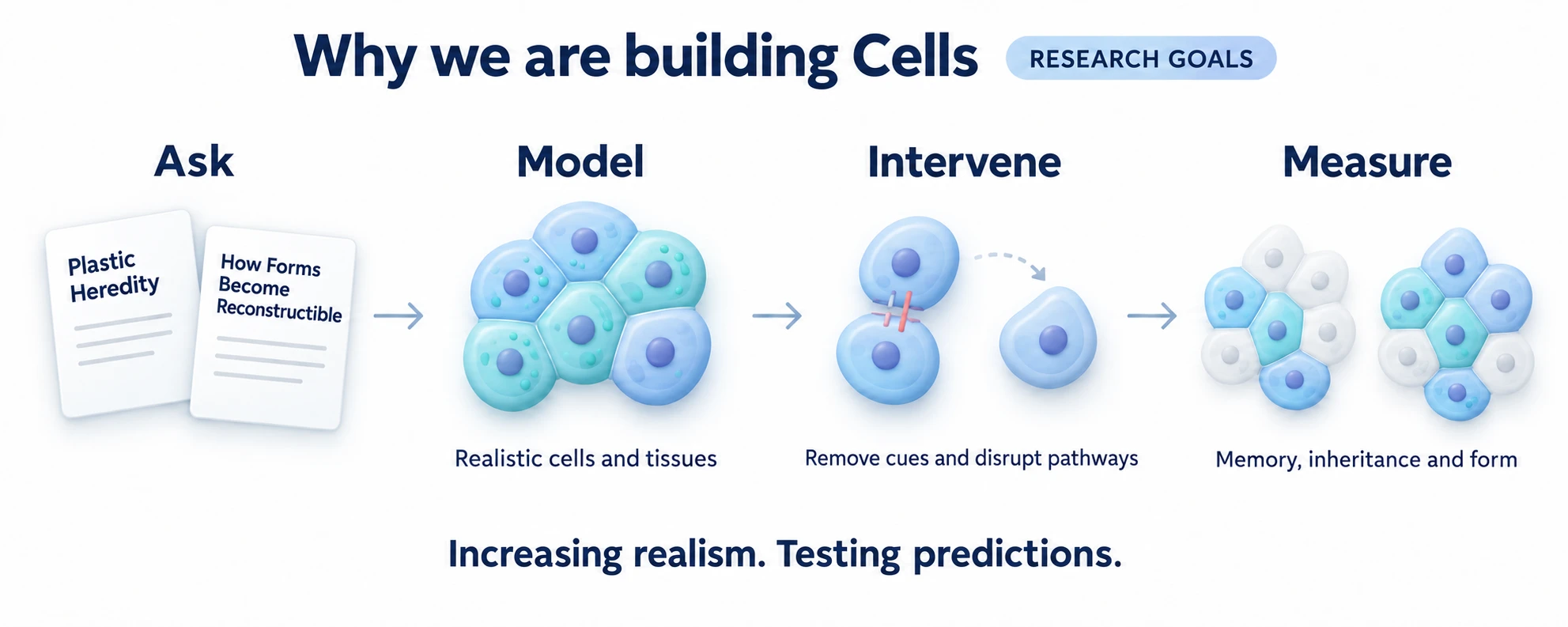
Plastic Heredity
When does inherited organisation break, recover, or persist? What allows an acquired state to pass to new carriers and be renewed?
Read the introductionHow Patterns Return
How do experience, retained cellular state, and tissue organisation affect which patterns and functions can be expressed, repaired, or rebuilt?
Read the preprintFrom molecular assembly to communicating cells.
The simulator brings together several model families, with explicit equations, numerical checks, and a record of what each model has been verified to do.
 View full-size illustration
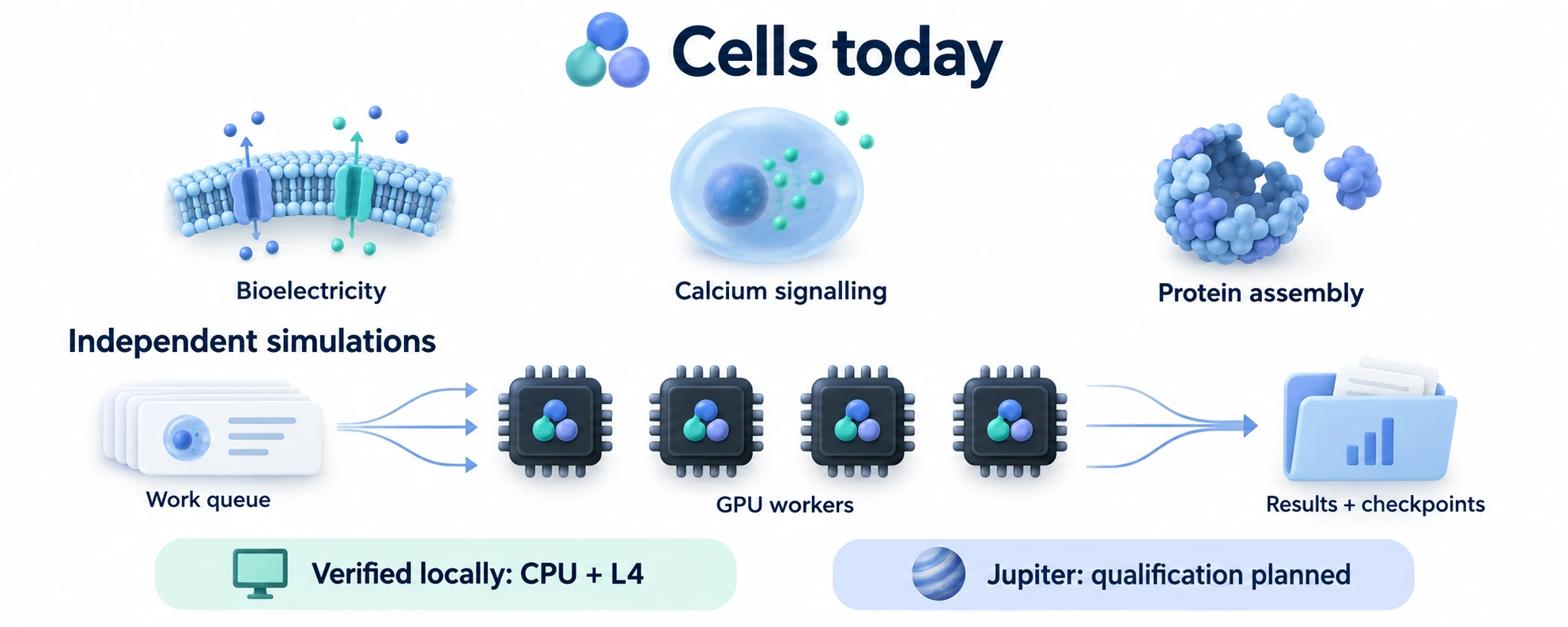
- Bioelectricity
- Ion transport, membrane voltage, pumps, channels, gap junctions, and extracellular fields in selected cell and tissue models.
- Cell chemistry and regulation
- Calcium and IP3 signalling, internal compartments, and chemical reactions, alongside isolated regulatory models and a bounded two-cell regulatory and ionic model.
- Protein assembly
- Stochastic cage formation, finite material pools, and breakable bonds. Connecting assembly to cell physiology is an experimental modelling hypothesis.
- Repeatable experiments
- Save a complete state, resume it, or branch into alternative futures. Run independent simulations with CPU references, local GPU comparisons, and conservation checks.
Toward whole cells, tissues, and organs.
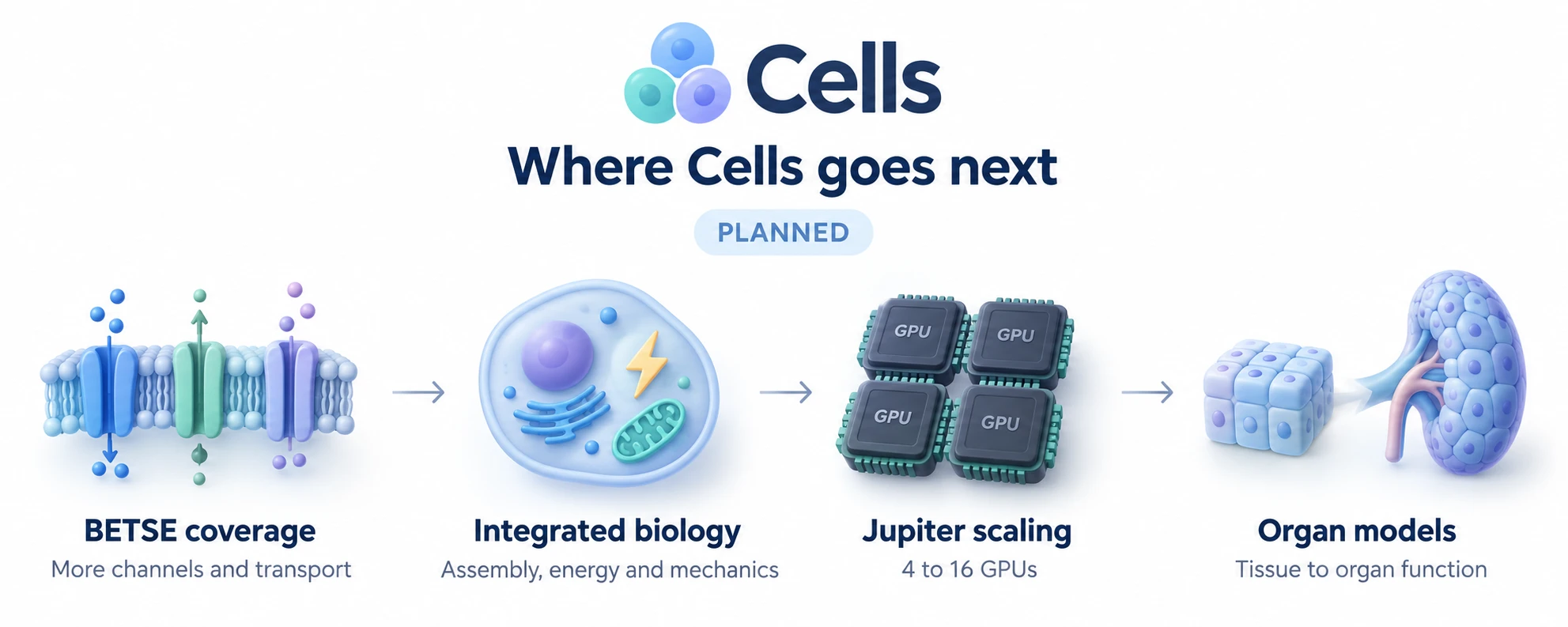
We’re working toward richer cell physiology, broader comparisons with the BETSE and BITSEY reference simulators, and experiments that test how cellular history is written, retained, and transmitted.
 View full-size illustration
Whole-cell models and interacting organ systems are long-term goals. Calibration against measured biology and qualification on Jupiter’s multi-GPU infrastructure remain ahead. Each comparison is tied to a specific model and set of conditions.
Explore the roadmapExplore the models.
Follow the evidence.
Cells is written in Python and JAX and released under the MIT License. The repository brings together the code, model guides, verification reports, and scientific background.
Project overview and illustrations adapted from the Cells README. See the repository for the latest status and evidence.