Our ambition is to develop cell-state treatments that help the body heal. Beneath biology’s complexity lie the mathematical laws of physics. As AI gets better at math, we’re using it to explore how the body takes shape, how information flows, and how cells make decisions.
Working with a team of human-directed AI scientists using frontier models, we have something to share: our first preprint, Plastic heredity: Predicting and steering how inheritance breaks, returns, and persists.
It explores a question beneath many of our larger ambitions: how does a system keep passing its organisation on, even as its ingredients and circumstances change? In computer simulations, we found a pattern we call plastic heredity. Inheritance can break, then become established again, without a return to the earlier form.
What is plastic heredity?
We usually meet heredity through DNA: information passed from parents to offspring. Our starting point was a simpler mathematical world, with no DNA at all.
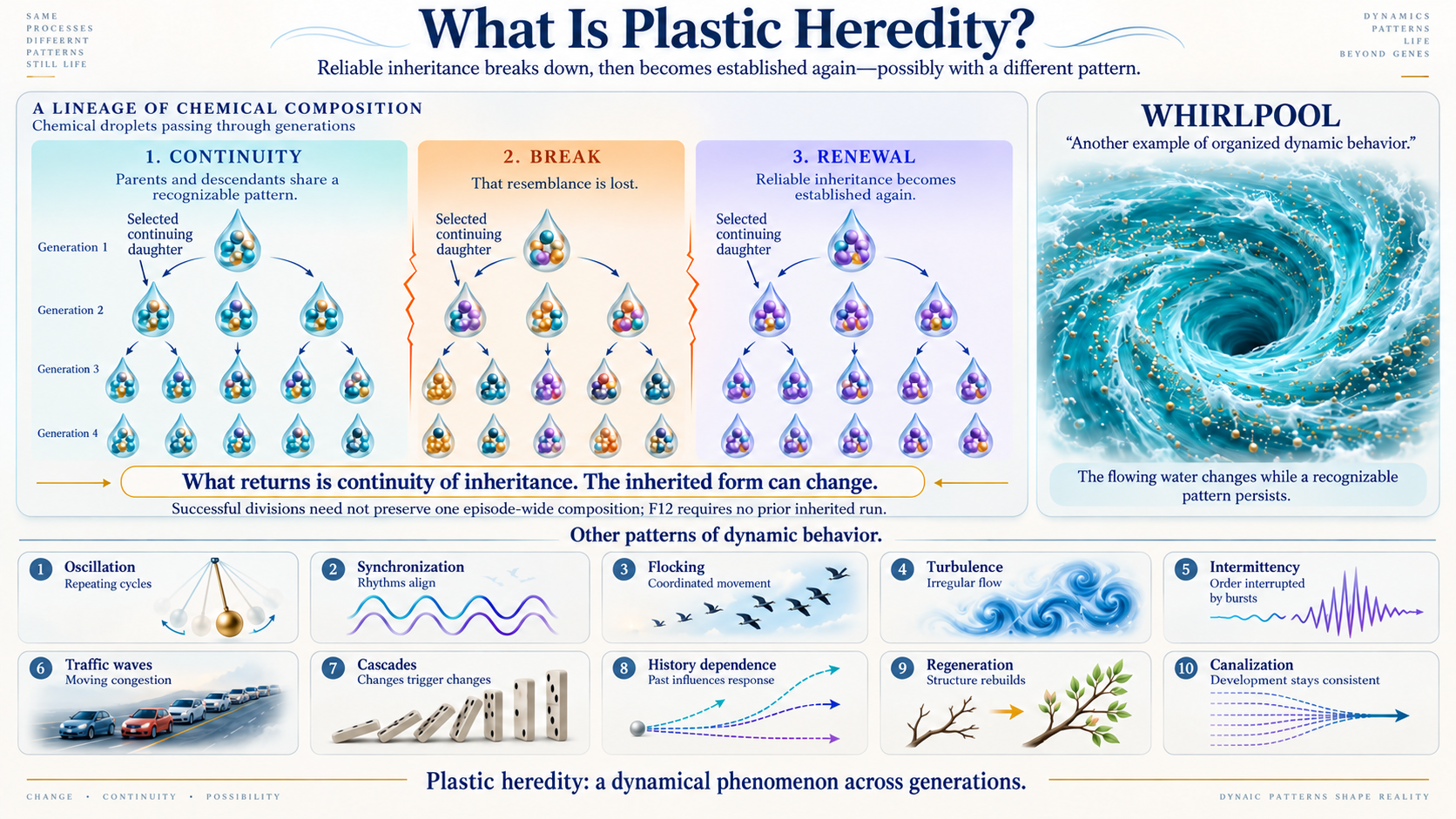
Imagine following a tiny assembly of molecules. It takes in ingredients, grows, and divides. We follow one daughter into the next generation. If its mixture of ingredients closely resembles its parent's mixture at division, we count that as successful inheritance.
Sometimes that resemblance fails. Later, the lineage may again pass the test for several divisions in a row. This loss and renewal of inheritance is the process we study.
In our main test, a break must be followed by three successful divisions in a row, within a window of twelve divisions. There does not have to be a successful run before the break. And the mixture can keep changing as each daughter grows: three successful handovers do not mean that every generation has the same composition.
What returns is the ability to pass something on. What is passed on can change.
Here, “plastic” means changeable: inheritance is a process that can be lost and renewed.
From watching inheritance to steering it
We began with GARD, an established origin-of-life model in which lipid-like molecules help one another join or leave an assembly. Our programme grew out of reconstructing work by Federico Pigozzi and Michael Levin on the emergence of self-replicators in this model.
Read Pigozzi and Levin’s preprint
The chance of a break followed by renewal depended on the assembly's current state and its chemical interaction rules. Across six reconstructed versions of GARD, prediction models fixed before testing performed better than the comparison model based only on past inheritance.
We could also change what happened next. Replacing selected molecules or changing the strength of their catalytic interactions shifted the chances of a break and renewal. We tested two useful questions separately: how to resist disruption, and how to recover after it.
Then we closed the loop. An external controller checked the assembly after each division and made a small molecular edit. With the controller active, inheritance succeeded at around 99% of divisions in extended tests running through 120 divisions.
That is a way to keep nudging a changing system towards continued inheritance. The effect depended on ongoing support: after we stopped controlling the assemblies, the composition established during control drifted away. We had demonstrated active maintenance, while lasting memory remained a separate question.
A similar pattern in different simulated worlds
We next asked whether break-and-renewal was specific to the molecular model. We found related patterns in two other kinds of simulation. Each model needed its own definition of a generation and of successful inheritance.
Cellular automata: patterns made from simple rules
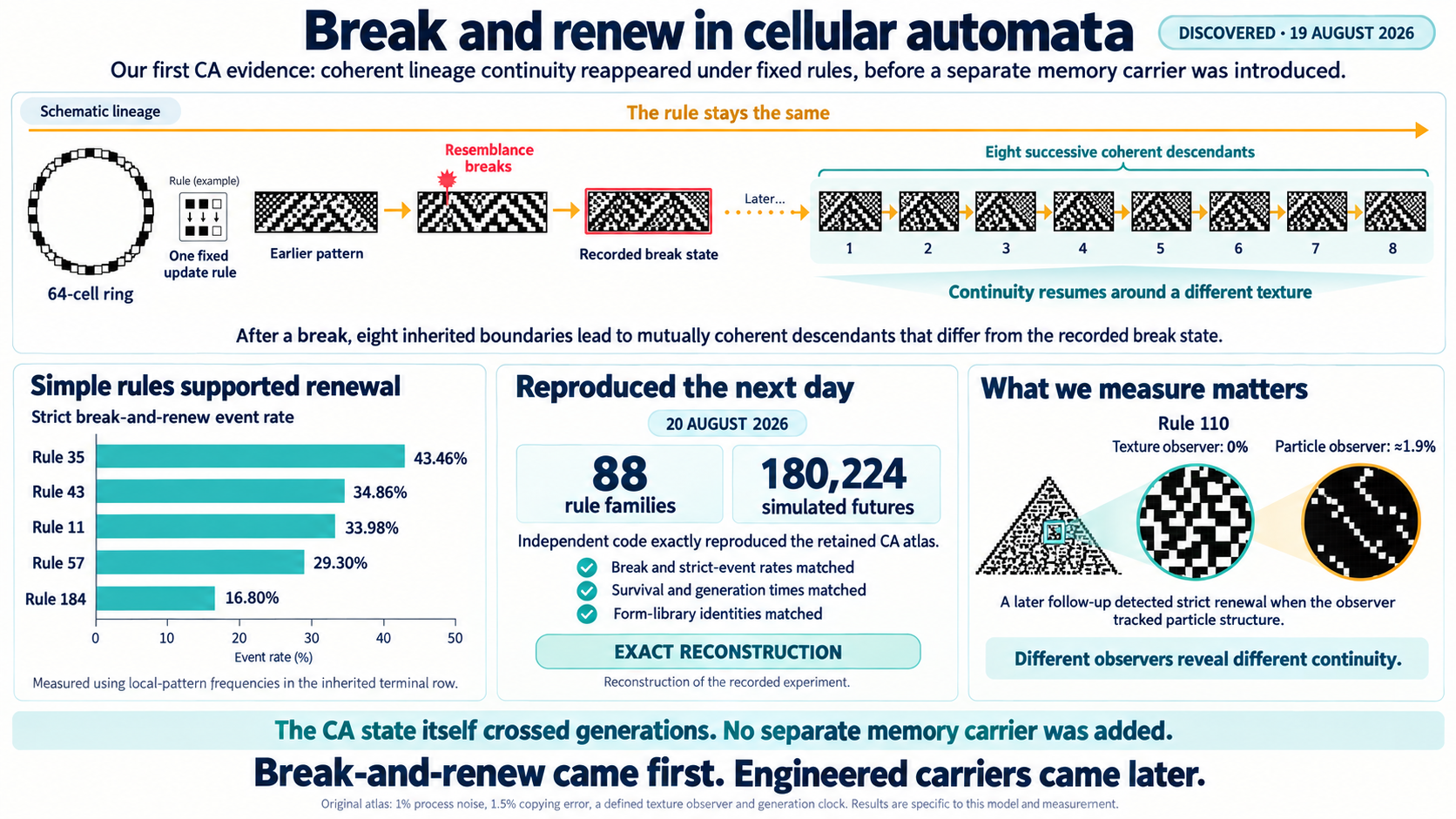
A cellular automaton is a digital world of little squares. Each square changes according to simple rules about its neighbours. These local updates can produce surprisingly rich patterns.
In some of these worlds, continuity broke and later resumed around a recognisable pattern, while the update rule stayed the same. A separate implementation reproduced the recorded results across 88 rule families. Which patterns counted as continuous depended on the rules and on what we measured, such as a texture or a moving structure.
Wagner networks: a model of interacting gene switches
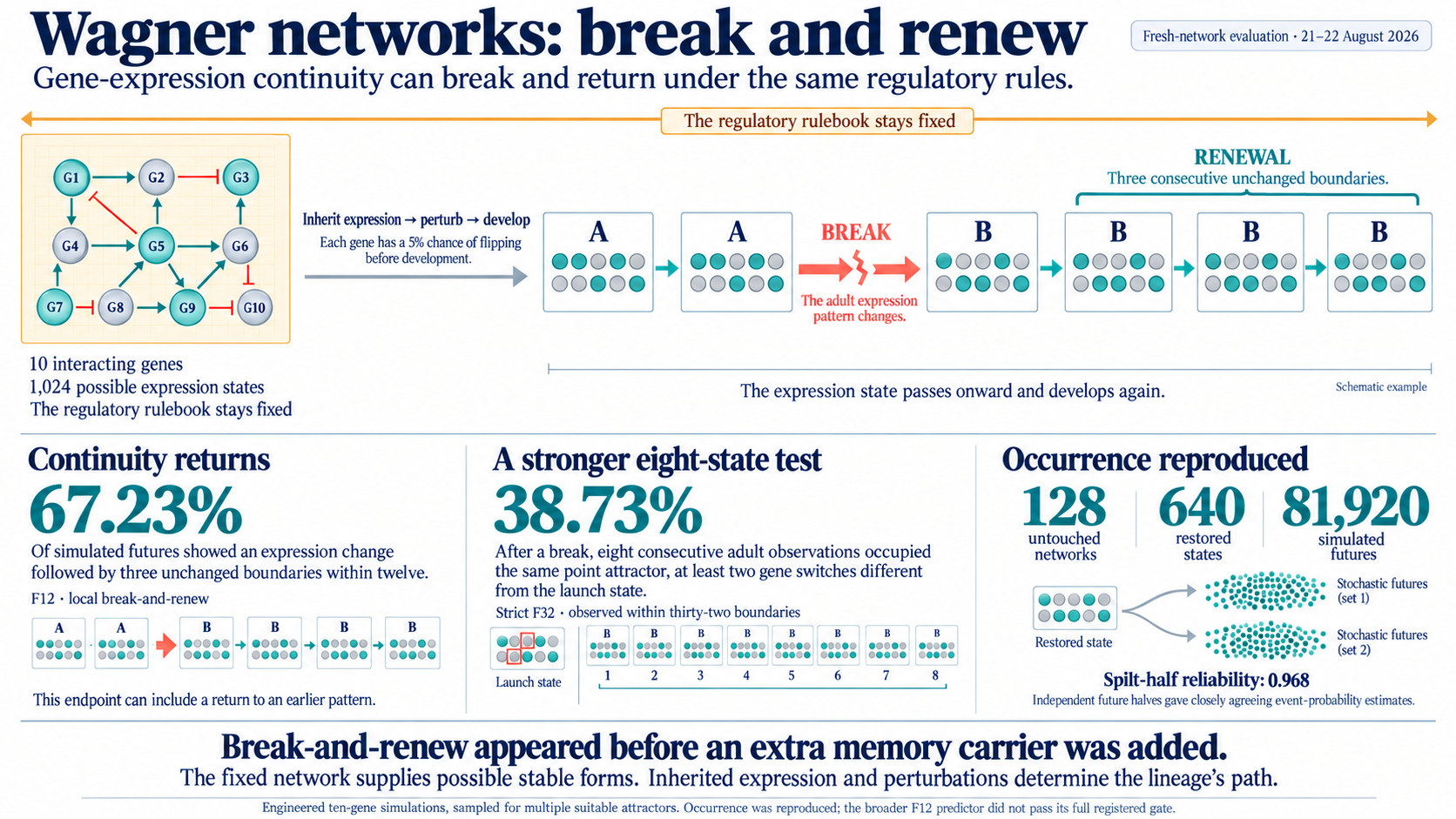
Wagner gene regulatory networks are simplified mathematical models of genes influencing one another's activity. Our simulations used ten interacting gene switches. The interaction rules stayed fixed, but the pattern of active genes could change.
Here too, an inherited pattern could change and then be passed on unchanged for several generations. This brings the question closer to cell states: which genes are active, and how a network settles into a pattern of activity.
What helps memory last?
A pattern reappearing does not, by itself, show that a lasting record has travelled through the lineage. To test that stronger idea, we later engineered an extra memory state into the cellular automata and Wagner networks.
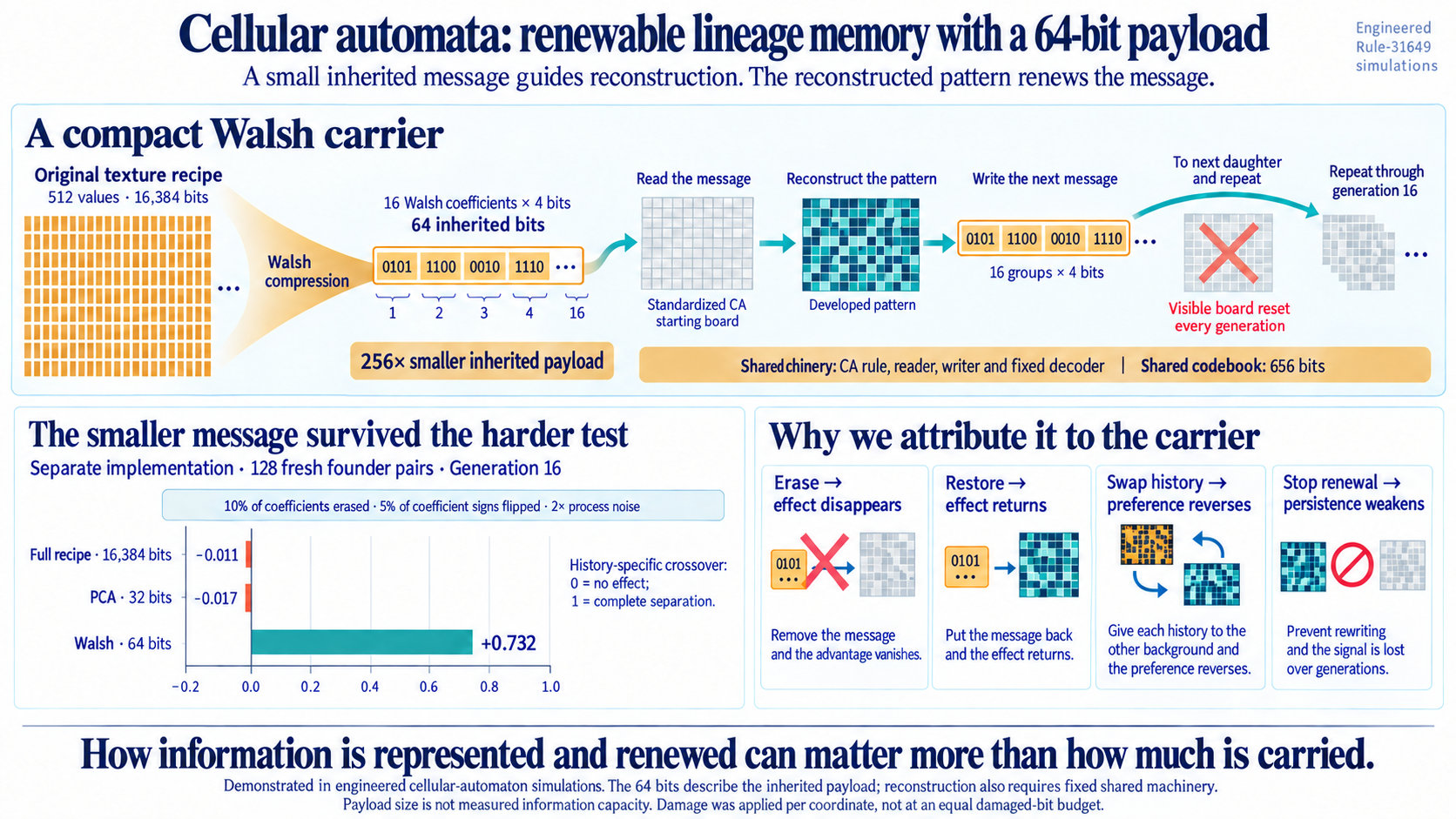
Think of it as a note passed between generations. The current pattern writes the note. A descendant receives it and reads it to help reconstruct a pattern. That resulting pattern refreshes the note for the next descendant.
The distinction is practical. A one-off cue can fade. In these experiments, a record that descendants could read and renew supported memory through generation 16, the longest generation tested in these carrier studies.
A small message in the cellular automaton
The cellular automaton carried a compact message of 64 bits, or eight bytes. That message worked with a fixed set of shared reading and writing rules; the eight bytes were the inherited message, not the whole reconstruction system.
The visible board was reset at each generation, so the old picture could not simply be copied forward. The message still guided descendants towards the pattern associated with their history, including under the tested noise and damage conditions.
A renewable record in the gene network
In the Wagner model, the added record stored the pattern of gene activity. After the descendant's expression state was reset, that record helped restore the pattern. The resulting gene activity then renewed the inherited record.
We tested whether the record was actually doing the work. Erasing it removed most of the effect. Restoring it brought the effect back. Giving it the opposite history reversed which pattern descendants favoured. Disabling reading, writing, or renewal weakened the result.
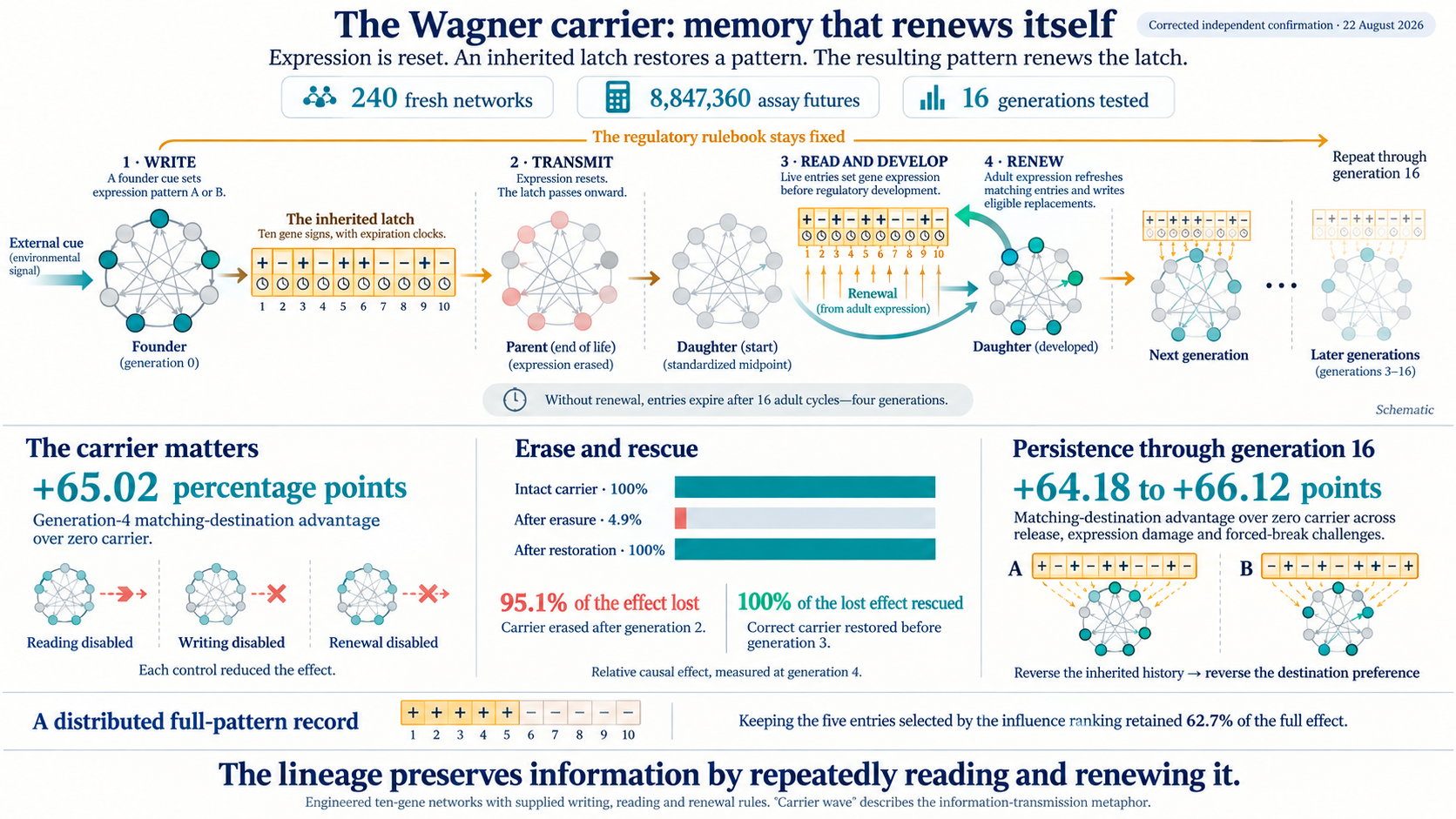
Together, these results suggest a working hypothesis: short episodes of heredity can arise from a system's ordinary dynamics, while more durable memory may need a slower changing record that can be passed on and renewed. We demonstrated ways to engineer such a record. How one might arise on its own remains an open question.
Why this matters for us
By a cell's state, we mean its current pattern of activity: which genes are active, which signals it responds to, and what it is doing. Our long-term ambition is to develop treatments that guide cells towards useful, healthy states.
That ambition makes the questions in this paper very relevant. How can we tell when a state is likely to lose continuity? What helps it resist disruption? What helps it recover? When will a brief intervention be enough, and when will continued support or a renewable memory be needed?
The origin-of-life question also becomes richer. Alongside asking when something first replicated, we can ask when inheritance became frequent, durable, and recoverable enough for evolution to build on it.
Human-directed research, scaled up by AI
This work is an example of human-directed research scaled up by AI. We worked with Eidosoma AI Scientist, Codex Sol, and Claude Fable to write code, run simulations, analyse results, check findings, create figures, and draft the paper.
We rebuilt the main simulations in separate codebases, froze predictors before confirmation tests, checked results on fresh simulations, and retained failed tests alongside positive ones. These checks happened within one research programme; they are not independent laboratory replications.
We are sharing the paper and research record so others can examine the methods, challenge the conclusions, and help shape the next experiments. This is the first step in a long voyage, we've just begun.